[et_pb_section fb_built=”1″ admin_label=”section” _builder_version=”4.16″ global_colors_info=”{}”][et_pb_row admin_label=”row” _builder_version=”4.16″ background_size=”initial” background_position=”top_left” background_repeat=”repeat” global_colors_info=”{}”][et_pb_column type=”4_4″ _builder_version=”4.16″ custom_padding=”|||” global_colors_info=”{}” custom_padding__hover=”|||”][et_pb_text admin_label=”Text” _builder_version=”4.27.2″ background_size=”initial” background_position=”top_left” background_repeat=”repeat” global_colors_info=”{}”]
Morgan Silver dollars are one of the most famous and popular coins in American numismatics. They were minted from 1878 to 1904, and again in 1921. Here’s a comprehensive overview of these iconic coins:
History
1. Designer: The coin was designed by George T. Morgan, an engraver at the U.S. Mint. The coin is often referred to as the “Morgan dollar” in his honor.
2. Creation: The Morgan silver dollar was authorized by the Bland-Allison Act of 1878, which aimed to increase the amount of silver that the U.S. government purchased from miners and put into circulation.
3. Minting Locations: Morgan dollars were minted at several locations: Philadelphia (no mint mark), San Francisco (S), New Orleans (O), Carson City (CC), and Denver (D).
4. Silver Content: Each Morgan dollar contains 0.77344 troy ounces of pure silver, making it a significant currency in terms of silver content.
Design Features
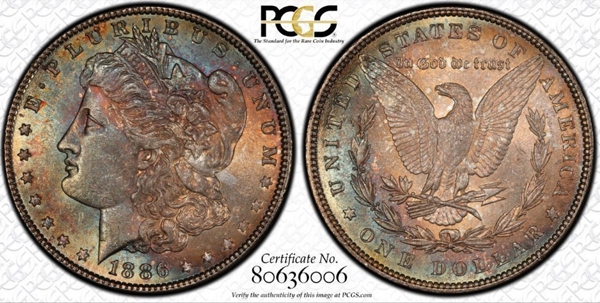
1. Obverse: The front features a profile of Lady Liberty wearing a Phrygian cap adorned with a laurel wreath. The words “LIBERTY” are inscribed above her head, with “E PLURIBUS UNUM” in the ribbon beneath.
2. Reverse: The back displays an eagle with outstretched wings, clutching arrows and an olive branch. The words “UNITED STATES OF AMERICA” encircle the eagle along with the denomination “ONE DOLLAR.”
3. Edge: The edge of the coin is reeded, a feature that deters counterfeiting and makes it easier to handle.
Variants and Rarities
1. Mint Marks: Coins from different mints are identified by different mint marks. The San Francisco mint produced the most desirable specimens due to their higher grades.
2. Key Dates: Some years are particularly sought after due to low mintage:
– 1889-CC: Very rare and highly collectible.
– 1893-S: Known for its scarcity, it commands high premiums.
– 1901-S: Another low mintage coin.
– 1921-D: The last year of issue, with limited mintage.
3. Proof Issues: A small number of proof coins were struck in 1879 and 1880, adding to the intrigue among collectors.
Collecting Morgan Dollars
1. Market: Morgan dollars are highly sought after by both numismatists and investors due to their historical significance and silver content.
2. Grading: The grade of a Morgan dollar impacts its value. Common grading scales include:
– Good (G)
– Very Good (VG)
– Fine (F)
– Very Fine (VF)
– Extremely Fine (XF)
– About Uncirculated (AU)
– Mint State (MS) for coins that have never been circulated.
3. Varieties: The Morgan dollar has several varieties and die variations that can affect value. For example, slightly different designs or minting errors can be highly prized.
4. Historical Context: The coin was minted during a time of significant change in America, including the expansion westward, the rise of industrialization, and the debate over monetary standards (gold vs. silver).
5. Investment: Many people buy Morgan dollars not just for their historical value, but also as a hedge against inflation, due to their silver content.
Current Value
1. Pricing: Prices can range significantly based on condition and rarity. Common dates in lower grades may sell for around $20-$30, while rarer dates in high grades can fetch thousands.
2. Market Fluctuation: The market for silver and historical coins can fluctuate based on precious metals prices, collector demand, and economic conditions.
Conclusion
Morgan silver dollars are not just a piece of currency but a part of American history. Their beauty, silver content, and historical significance make them a prized possession for many collectors. Whether you’re looking to invest, complete a collection, or appreciate their artistry, Morgan dollars offer a rich blend of history and value.
[/et_pb_text][/et_pb_column][/et_pb_row][/et_pb_section]
